Roman Provence: What to See near Nîmes
Between Nîmes, the Pont du Gard and the Rhône valley, you're staying in the heart of one of Europe's richest concentrations of ancient monuments — a place where, in twenty minutes by car, you go from a Roman amphitheatre still in use to an abbey carved straight into the rock.
This isn't a checklist. It's the way we, who know these places, would plan a few days of discovery — from the must-sees to the quieter corners, each with what to see, when to go, and how to chain them together from our houses without spending the day in the car.
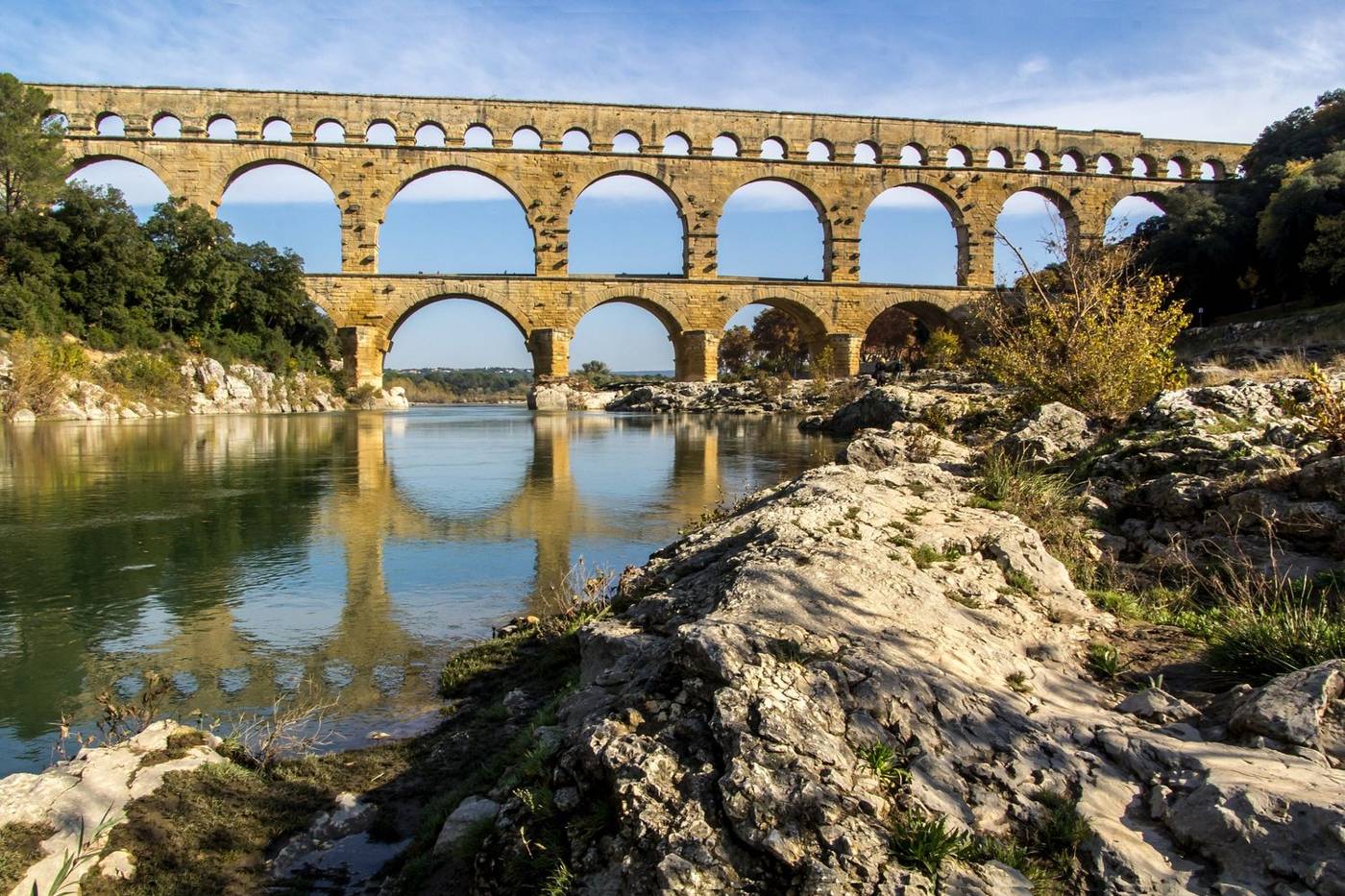
The Pont du Gard, a marvel of Roman engineering
About twenty minutes from Nîmes, the Pont du Gard is the most visited ancient monument in France — and it earns its reputation. What looks like a bridge is in fact the most spectacular stretch of a nearly 50 km aqueduct, built in the mid-1st century AD to carry water from the Eure spring near Uzès all the way to Nemausus, Roman Nîmes. Over that entire course, the drop is barely a dozen metres: that invisible precision is the real feat.
Standing almost 49 metres high on three tiers of arches, it's the tallest Roman aqueduct bridge still standing, and the only surviving three-level one in the world. Most of it was built without mortar, some stones weighing up to six tonnes, cut from golden limestone quarried just downstream. A UNESCO World Heritage Site since 1985, it had already awed Rousseau and Stendhal long before today's visitors.
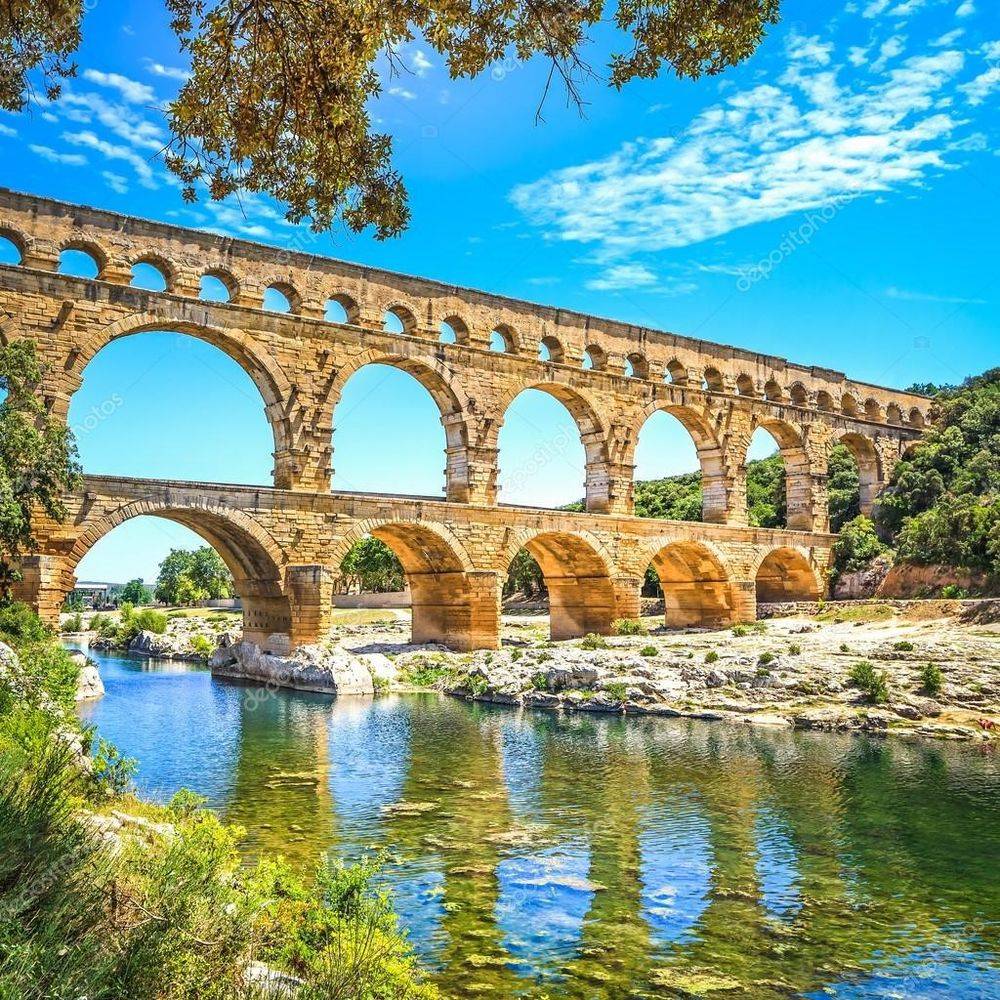
There's far more to do than look. The museum is genuinely good on Roman hydraulics; the "Mémoires de garrigue" trail, an easy 1.4 km loop through vines, olive trees and holm oaks, follows the line of the aqueduct and works well with children. In summer, people come above all to swim in the Gardon — the landscaped banks below the monument turn into a beach, and there's no finer backdrop for a picnic. After dark in July and August, the bridge becomes the screen for a light show.
Good to know: the walkway you cross today isn't Roman — it's an 18th-century road bridge added alongside. And for cyclists, the Uzès–Beaucaire greenway (around thirty traffic-free kilometres) passes the site.
Roman Nîmes
Staying in Nîmes, or minutes away? You have the ancient heritage on your doorstep. The Arena, one of the best-preserved Roman amphitheatres in the world, still hosts shows and concerts; the Maison Carrée, a UNESCO-listed temple since 2023, is one of the most intact Roman buildings anywhere; the Tour Magne crowns the city above the Fountain Gardens. You finish at the castellum, the round basin where the Pont du Gard's water actually arrived before flowing into the city, then the Musée de la Romanité, facing the amphitheatre.
That's a full day, on foot, without touching the car. We detail it all — addresses, order of visit, food stops — in our Nîmes guide.
Arles, two thousand years of history
Half an hour away, Arles rivals Nîmes for Roman heritage: an amphitheatre, an ancient theatre, the cryptoporticus — underground galleries that once supported the forum — the Baths of Constantine and the Alyscamps, a long necropolis lined with sarcophagi that Van Gogh and Gauguin both painted. The whole ensemble is UNESCO-listed.
But Arles doesn't stop at antiquity, and that's what makes it such a full day. The Musée de l'Arles antique (the "blue museum") displays an entire Roman barge raised from the Rhône. Van Gogh painted more than three hundred works here in fifteen months. And the LUMA tower, designed by Frank Gehry, plants a contemporary-art spaceship opposite the Roman ruins — a leap across the centuries that sums up the city. In summer, the Rencontres de la Photographie turn Arles into a world capital of the image.
Montmajour Abbey
Ten minutes from Arles, Montmajour Abbey rises on a former rocky islet above marshes that have long since been drained. Founded by Benedictine monks in the 10th century, it combines a bare Romanesque church and crypt, a cloister, and a fortified tower whose view sweeps over the Alpilles, the Crau and the Camargue. Van Gogh loved to come and draw here. It's a site the classic tours often skip — exactly the kind of stop that makes a trip.
Tarascon, Beaucaire & Saint-Roman
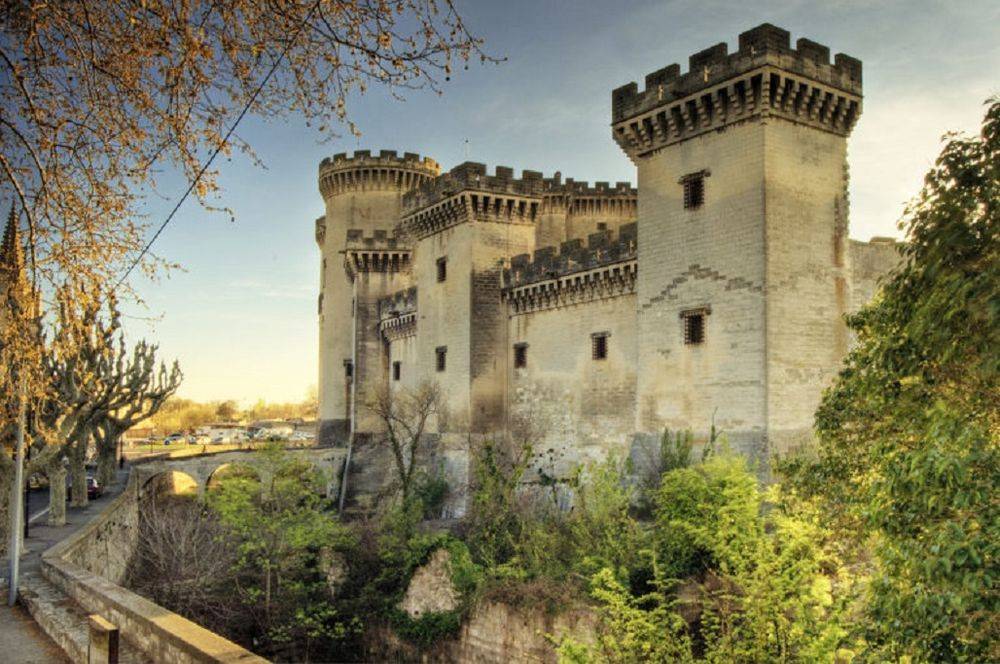
On the banks of the Rhône, the Château du Roi René in Tarascon is open to visit — one of the best-preserved medieval castles in France, standing directly opposite the fortress of Beaucaire on the far bank: two strongholds that long stared each other down, back when the river marked a border between two realms.
Just above Beaucaire, don't miss the rock-cut abbey of Saint-Roman: entirely carved into the stone, with its chapel, cells and an open-air necropolis hewn from the rock, it's unique in Europe — and the viewpoint over the Rhône valley is superb.
Glanum & Uzès
At the gates of Saint-Rémy-de-Provence, the ancient site of Glanum announces itself from afar with "Les Antiques": a triumphal arch and a mausoleum, standing free by the roadside. Behind them, the Greco-Roman town spreads up the hillside. Next door, the cloister of Saint-Paul-de-Mausole, where Van Gogh was treated, is worth the detour.
Towards Uzès, the first duchy of France, you'll stroll under the arcades of the Place aux Herbes (a glorious Saturday market), beneath the Tour Fenestrelle, France's only round Romanesque tower. It's also here, at the Eure spring, that the Pont du Gard's water was born: the loop comes full circle.
Our one-day itineraries
This is where staying direct, in the right spot, changes everything. Here's how we'd plan a day from each of our bases.
From our Nîmes apartments (Denim · Garance · Oslo). A Roman morning on foot — Arena, Maison Carrée, Tour Magne — then lunch at the covered Halles market (brandade, local goat's cheese, a glass of Costières). In the afternoon, head to the Pont du Gard (25 min): the monument, the garrigue trail, and a swim in the Gardon in season. The next day, a full day in Arles (35 min) or an escape to Uzès and its market square.
From Le Mas des Prépresses (Beaucaire). You're perfectly placed between two worlds. In the morning, the Beaucaire fortress and the Saint-Roman abbey just above, then cross the Rhône to the Château du Roi René in Tarascon (5 min). In the afternoon, your choice: Arles (25 min) for antiquity and Van Gogh, or the Pont du Gard (30 min) for a swim. Montmajour slots in perfectly on the way to Arles.
FAQ
Where should I start?
With Nîmes (a full day on foot) and the Pont du Gard (half a day): that's the heart of Roman Provence, all within easy reach. Arles makes an excellent second day.
How long do I need to see everything?
Allow three to four days at a relaxed pace: a day in Nîmes, a day for the Pont du Gard + Uzès, a day for Arles + Montmajour, and a half-day for Tarascon–Beaucaire–Saint-Roman.
Can I visit without a car?
Nîmes and Arles, yes (both are on the train line). The Pont du Gard, Tarascon, Glanum and Saint-Roman are far easier by car. By bike, the greenway links Uzès to the Pont du Gard and on to Beaucaire.
Is it good for children?
Very much so. The Pont du Gard has a kids' discovery space and swimming; the arenas of Nîmes and Arles speak to all ages; and Montmajour, with its tower to climb, appeals to younger ones. See also our family guide.
Are the sites open year-round?
Most are, with reduced hours in winter and a few closing days. Always check the official websites before setting off, especially off-season.